

IRS Whistleblower Program: How Rewards Work
The IRS Whistleblower Office pays awards to whistleblowers who report specific and credible information whose information results in the collection of taxes, penalties, interest or other amounts from the non-compliant taxpayer. Learn more about the IRS Whistleblower Program in this detailed FAQ.
August 10, 2026


This information is provided for educational purposes only by Kohn, Kohn & Colapinto and does not constitute legal advice. No attorney-client relationship is created by accessing this content. Laws and regulations may change, and this material may not reflect the most current legal developments. If you believe you have a whistleblower claim, consult a qualified attorney to discuss your specific circumstances.
Introduction
The IRS Whistleblower Office was established in 2006 to administer the IRS Whistleblower Program, which awards eligible individuals who report specific and credible information to the IRS, which results in the collection of taxes, penalties, interest or other amounts from the non-compliant taxpayer.
The type of non-compliance can range from illegal offshore tax evasion and illegal shell bank accounts, to false reporting, pyramiding, and the simple underpayment of taxes.
The IRS Whistleblower Program is one of the strongest anti-fraud award programs available to tax whistleblowers who report tax evasion and fraud. Since it’s inception in 2007, the IRS has paid over $1.3 billion in awards, and collected over $7 billion from tax non-compliance.
Some of the key features of the program include the following:
- Awards: Whistleblowers may be eligible for an award between 15 and 30% of the proceeds collected and linked to their information.
- Related Actions: Permitting the payment of rewards based on sanctions obtained from other law enforcement agencies.
- Protection: the IRS prohibits retaliation against whistleblowers for reporting tax fraud, underpayment, or other illegal activities.
- Confidentiality: Although anonymous filing is not permitted, the IRS takes strong measures to protect confidentiality.
- International: Non-U.S. individuals may blow the whistle on major tax non-compliance or fraud by U.S. taxpayers or those who assist them. For a full breakdown of how this works in practice, see this international whistleblower guide on reporting tax evasion to the IRS.
Below is a brief overview of the IRS Whistleblower Program with important information about these key features, and steps to becoming a whistleblower if you have information about tax non-compliance or fraud.
History of the IRS Whistleblower Office
The IRS Whistleblower Office was established by the Tax Relief and Health Care Act of 2006. This office is tasked with processing tips from individuals, such as whistleblowers, who have knowledge of significant tax noncompliance to provide that information to the IRS.
A principal reason for enacting the law is that Congress recognized that detecting tax evasion and tax fraud is very difficult for the government to detect due to their complexity and the lack of resources to audit or investigate all returns.
The office pays monetary awards to individuals whose information is used by the IRS. The percentage of the award falls between 15 and 30% of the proceeds collected and linked to the whistleblower’s information. The percentage a whistleblower receives mary vary, depending on various award factors.
As a result of enacting a robust tax whistleblower law, the IRS receives reports of serious tax fraud from whistleblowers, many of whom have inside knowledge of the complex financial transactions and other illegal conduct that results in tax fraud.
Whistleblowers often provide extensive documentation to support their claims that would not have been otherwise known to the IRS.
IRS Whistleblower Rewards & Awards
The IRS calls this an award — many people search for it as a whistleblower reward. They refer to the same payment
Individuals who provide information leading to the collection of taxes may receive an award (sometimes called a reward) of 15 and 30% of the collected proceeds. To become eligible, the tax non-compliance must first meet the following criteria:
- Taxpayer Income: The taxpayer’s gross income must exceed $200,000.
- Amount in Dispute: The amount of taxes in dispute must exceed $2 million.
In referring to awards, the IRS may use the term proceeds, which refers to penalties, interest, taxes, and any other amounts collected due to the IRS’s enforcement of tax laws, including criminal fines, civil forfeitures, and violations of reporting requirements.
There is no contract required to receive a whistleblower reward from the IRS. It’s advised that whistleblowers obtain legal representation, as the whistleblowing and award process is complex. Failure to meet any the requirements may result in your case being denied or dismissed.
Reduced Awards
If the information provided is based on publicly available sources, which is considered “less substantial,” the award may be reduced to an award of no more than 10% of the proceeds collected as a result of the action, related actions, or settlements.
No Award
It is also possible for a whistleblower to be ineligible for an award if they were involved in planning or initiating tax evasion. In fact, these whistleblowers may actually face criminal charges.
Related Actions
Additional compensation may also be available if a whistleblowers initial information leads to continued investigations or legal actions that lead to tax collection. This is most common if the information triggers a broader investigation that uncovers subsequent tax evasion or fraud.
Remedies
Employees who win a retaliation case my be entitled to full compenation, including damages, such as back pay, full benefits, and interest. They can also recover costs like attorney fees or witness fees. In summary: if they are relatiated against, they are entitled to a full range of remediesto make them whole, and they cannot wave the right under this law.
IRS Whistleblower Awards Paid Since Inception
Since issuing the first award in 2007, the IRS Whistleblower Office has collected over $7.5 billion from non-compliant taxpayers, and have paid awards totaling over $1.3 billion. Whistleblowers play a vital role in bolstering the fair and effective enforcement of nation’s tax laws.
IRS Whistleblower Award Amount Paid Each Year
IRS Awards Paid Each Year
IRS Whistleblower Office Annual Reports
In fiscal year 2024, the IRS Whistleblower Office paid $123.5 million in awards based on $474.7 million collected from noncompliant taxpayers, and established 14,926 new award claims — a 13% increase over the prior four-year average. To get a complete breakdown of the awards paid by year, we suggest reading the following annual report, which are put out each year by the IRS Whistleblower Office:
- Whistleblower Office FY2024 Annual Report
- Whistleblower Office FY2023 Annual Report
- Whistleblower Office FY2022 Annual Report
- Whistleblower Office FY2021 Annual Report
IRS Whistleblower Protections
Employers are prohibited from retaliating against employees for reporting any sort of tax non-compliance, fraud, or other violations, or assisting the IRS in an investigation. This means they may not discharge, demote, suspend, threaten, harass, or in any other manner discriminate against an employee in the terms and conditions of employment for doing what’s legally right.
Employees who experience relaliation can file a complaint with the Secretary of Labor or sue in federal court, but only if the Secretary of Labor fails to act within 180 days. There are specific procedures and rules outlined in other federal laws with these cases. It’s important for employees to know that they have 180 days to file a complaint from the date in which the retaliation started. In cases that go to court, employees have the right to a jury trial.
Anonymous Tips
The IRS does not allow for anonymous whistleblowing. However, they do vow to maintain strict confidentiality throughout the process.
Still, there are ways submit a tip without revealing your identity. This includes hiring a whistleblower lawyer who can file a whistleblower tip on your behalf, and act as an intermediary between you, the IRS and courts. A whistleblower attorney also has a solid understanding of the law and will protect your identity to the extent possible under law—if you experience retaliation, a whistleblower attorney can help you file a complaint immediately.
What Is IRS Form 3949-A?
There are two forms for reporting tax fraud to the IRS. Form 3949-A is a general tip that can be filed anonymously but does not qualify you for an award. Form 211 is the formal whistleblower claim that makes you eligible for 15–30% of collected proceeds but requires your identity. See the full breakdown of Form 3949-A vs. Form 211
The IRS Whistleblower Program Process
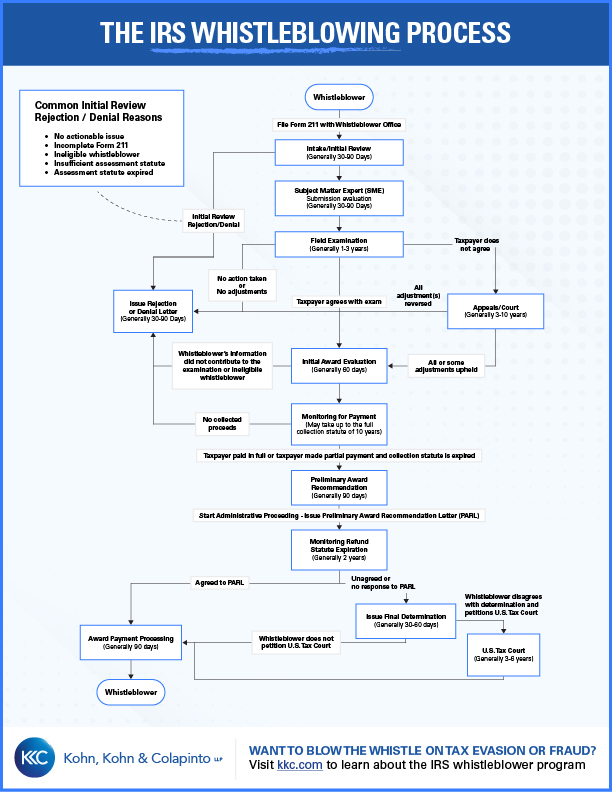
Filing an IRS whistleblower claim involves determining your eligibility, gathering specific and credible documentation, and submitting Form 211 to the IRS Whistleblower Office. The process can take several years from submission to award. For a full breakdown of each step — including which form to file and how to protect your identity — see our complete guide: How to Report Tax Fraud to the IRS: Step-by-Step →
Seek Legal Assistance
Kohn, Kohn and Colapinto has been in the trenches of IRS whistleblower protection for over 35 years. Our firm is behind roughly a third of all IRS whistleblower cases, including the landmark Bradley Birkenfeld case that exposed Swiss banking and landed Birkenfeld an award of $104 million, the largest at the time.
Not to mention, we have filed rulemaking petitions, testified at rulemaking hearings, filed amicus curiae briefs in precedent-setting tax whistleblower cases, and helped push for legislation to improve the efficacy of the IRS Whistleblower Program.
Your initial consultation is free and confidential, and in many cases our attorneys work on a contingency basis. Meaning, we only get paid if we get an award for you. Contact our firm today if you’re seeking a top IRS whistleblower attorney to work on your case.
Thinking about reporting IRS tax fraud?
KKC’s IRS whistleblower attorneys have recovered over $X for clients.
Schedule a free consultation
Our Firm’s Cases

$158 Million Award
Our whistleblower reported 496 U.S. citizens evading taxes, with several major offshore banks involved. In addition to the 496-offshore tax case, Kohn, Kohn and Colapinto is the only firm to have helped more than three clients obtain awards over $100 million.

$112.6 Million Award
Confidential Whistleblower’s disclosures resulted in 461 tax cheats paying over $562.9 million in fines and penalties. Whistleblower obtained awards of over $112.6 million. Client’s disclosures expected to trigger millions in additional awards and sanctions in 2024.

$11.9 Million Award
In July 2023, our client was awarded a significant sum of $11.9 million due to their involvement in the Tax Whistleblower Award Case No. 2015-11701. The IRS’s program for whistleblowers is a crucial mechanism that incentivizes individuals to spotlight tax fraud.


